
As Vietnam seeks to combine economic development with environmental protection, EPR in Vietnam is one way to bring businesses into the circular economy. It is a legal obligation and part of the shift toward greener production and consumption.
In Vietnam, the EPR mechanism is officially regulated in Articles 54 and 55 of the Law on Environmental Protection 2020, along with detailed instructions in Decree 08/2022/ND-CP. In particular, the responsibilities of manufacturers and importers are divided into two main pillars:
- Responsibility for recycling products and packaging after use.
- Responsibility for waste treatment.
This article focuses on recycling responsibility, a central part of EPR in Vietnam.Learn more here!
1. EPR and recycling responsibility: What businesses need to know
EPR requires producers and importers to take responsibility for products and packaging after use. They may arrange collection and recycling or make a financial contribution to support recycling, as the rules allow.
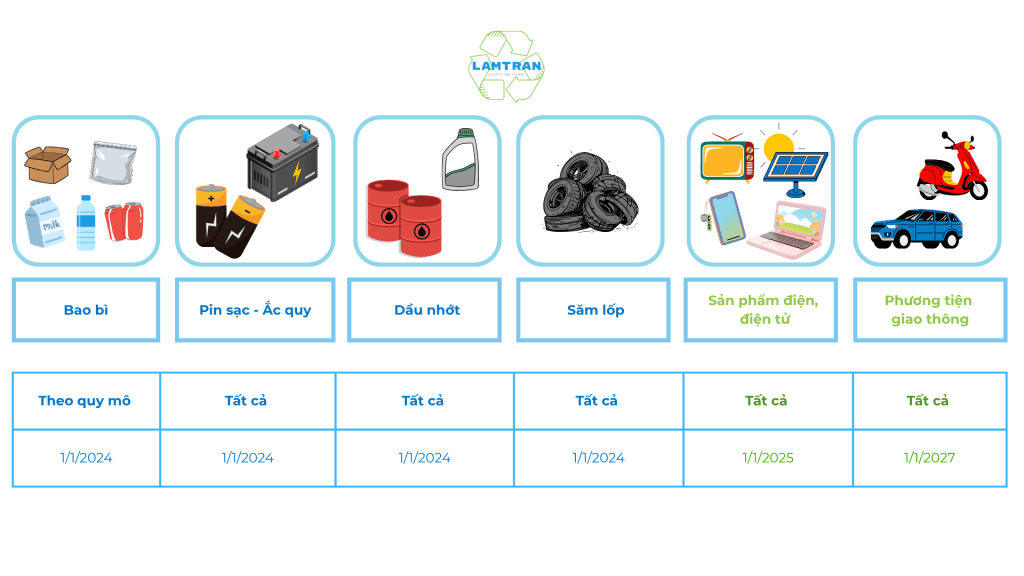
According to Vietnamese regulations, EPR not only applies to large enterprises, but also extends to many groups of manufacturing and import industries that affect the environment, especially the packaging, electronics, vehicles, batteries, accumulators, lubricants, and tires industries.
See more:What are recycled plastic pellets? Benefits and applications
2. EPR in Vietnam: Covered Businesses and Implementation Timetable
According to Clause 1, Article 77 of Decree 08/2022/ND-CP, organizations and individuals producing and importing the following product groups must carry out recycling responsibilities:
- Packaging
- Batteries and accumulators
- Lubricant oil
- Tires and inner tubes
- Electrical and electronic equipment
- Vehicles
Manufacturers and importers specified in this Article are organizations and individuals responsible for the quality and labeling of products and goods in Vietnam, according to the provisions of law on goods quality.
Vietnam began phasing in EPR obligations for certain product groups in 2024. Packaging attracts particular attention because it is widespread and difficult to manage without proper collection and recycling.
3. EPR regulations for commercial packaging groups
According to Clause 2, Article 77 of Decree 08/2022/ND-CP, commercial packaging subject to recycling responsibility includes types used for:
- Food according to food safety regulations (except chewing gum).
- Cosmetics according to regulations on cosmetic production conditions.
- Drugs according to the provisions of pharmacy law.
- Fertilizers, animal feed, veterinary medicine.
- Cleaning preparations for household, agricultural and medical use.
- Cement.
4. Concept of commercial packaging according to Decree 43/2017/ND-CP
Clause 5, Article 3 ofDecree 43/2017/ND-CPdefines commercial packaging as packaging that contains goods and circulates with them. It includes direct and outer packaging:
- a) Direct packaging is the packaging that contains the goods, is in direct contact with the goods, creates a shape or is tightly wrapped according to the shape of the goods;
- b) Outer packaging is the packaging used to package one or several units of goods with direct packaging;
Responsibility for recycling this packaging generally falls on the party placing the packaged product on the Vietnamese market. For example, if Company A buys packaging from supplier B and sells products under its own brand, Company A is responsible for recycling products sold in Vietnam; exported products are treated differently.
Thus, most consumer goods industries are obliged to recycle packaging, especially for products distributed domestically.
5. Cases where recycling liability is exempted
Not all businesses are required to implement EPR. According to regulations, subjects who are not responsible for recycling packaging include:
- Manufacturers and importers of products for export or temporary import - re-export, or for research, study, and testing.
- Producers and importers with annual revenue from products and packaging below VND 30 billion.
- Packaging manufacturers recover, reuse or recycle their own packaging to package new products, achieving a rate equal to or higher than the required recycling rate.
These regulations help ensure fairness and feasibility, encouraging businesses to proactively recycle instead of just making financial contributions.
6. Meaning and benefits of implementing EPR
The application of EPR brings many practical benefits to both businesses and society:
- Contribute to environmental protection: Reduce the amount of plastic waste, packaging and non-degradable waste.
- Promoting circular economy: Enhance recovery and reuse of raw materials, save natural resources.
- Improving brand image: Enterprises that comply with EPR demonstrate social responsibility and easily access international markets.
- Legal compliance: Helps businesses avoid sanctions, while creating a competitive advantage in the trend of "greening" the supply chain.
7. How should businesses start implementing EPR?
To meet EPR regulations, businesses should:
- Review products and packaging to determine whether EPR applies.
- Register a recycling plan with the responsible authority.
- Choose the form of EPR implementation:
- Organize recycling directly or through an authorized partner.
- Make a financial contribution to the Vietnam Environmental Protection Fund.
Monitor progress and report results periodically to demonstrate compliance.
Conclusion
EPR in Vietnam is an important part of the country’s sustainability strategy. Following the rules helps businesses meet their legal obligations and can strengthen competitiveness as the economy becomes greener and more circular.
Contact EPR consulting today!
If your business needs support in implementing EPR, providing soft packaging recycling solutions, or consulting on the roadmap and regulations for implementing EPR recycling in Vietnam, please contact Lam Tran Plastic Recycling Joint Stock Company - a pioneer in the field of soft plastic packaging recycling.
Lam Tran always accompanies businesses in the journey of implementing environmental responsibility - sustainable development - spreading green values.